Day in the Life: Cameron Marr, iNED, Board Chair and Audit, Risk, Nomco and Remco Committee Chair in the U.K. and Ireland
Posted on 16th September 2025
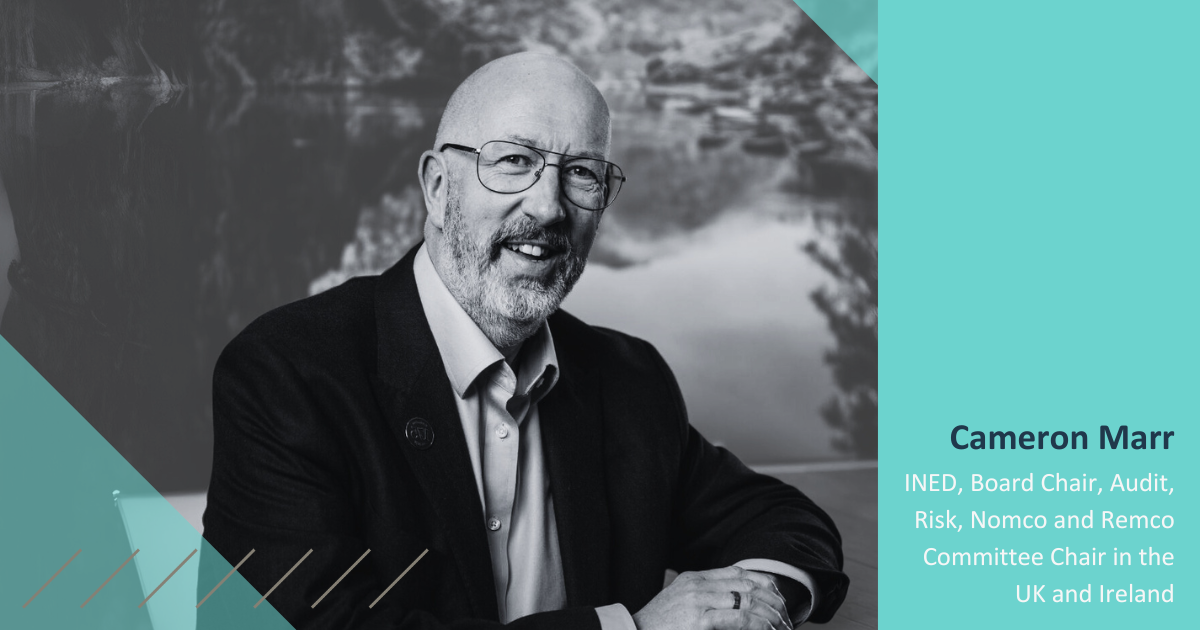
With decades of C-suite and Boardroom experience across the UK, Ireland, and international markets, Cameron Marr has retained an unshakeable belief in the value of building the right team, finding your lane and staying true to your own values.
We discussed the every-changing skill set needed to be an effective iNED today – from building trust and safe spaces, to challenging with humility – as well as how to manage the most dangerous of opponents, a snake in the Boardroom grass…
He also shared insights into how he measures risk (and occasionally gets it wrong and offers a sneak peek into the potential pages of his not-yet-penned novel (you read it here first)!
What advice would you give someone moving into your sector?
You are going to have to kiss a lot of frogs. Often when you’re kissing the frog, you don’t really know what you’re kissing. You think ‘that company looks good,’ but you don’t know for sure, because they have an image that has been developed over time and that they wish to project, and what you’re engaging with is their image. In reality, it is not until you are inside a company that you get to see exactly what you are dealing with.
“Be prepared to take some risks, or you’ll never make the leap“
Being on the Board, or being the Chair of the board, is a little like being the owner of a football team, but you’re never get to see the team play. You call after their Saturday game and ask the Manager how it went. You’re told it went well, and they won five-nil. Great! The Manager was honest, so you rest happy. What he didn’t tell you was that the lead striker broke his leg and is going to be out for six weeks, and the 50,000-capacity stadium only had 250 spectators, so you have a looming financial issue… but they won five nil! This is where we sit as an INED. We depend completely on the information provided to you by the management, filtered through the senior management team, CEO and/or the executive directors. This information can be truthful, but it can also be partial and may not be fully transparent. That’s why the first thing you need to assess is the quality and competence of the management team and crucially, if you can build a relationship of trust with them, especially when things don’t go exactly as planned. You need to be confident that the management will be transparent and honest with you throughout your journey with an organisation and not provide truthful but partial information.
That said, of course, in your search for positions on boards I really think that you must be prepared to take some risks, or you’ll never make the leap!
LB: How do you set what is comfortable for you with regards to your own risk?
Experience is critical, and you have to accept that you are going to get it wrong. You’re either going to miss some fantastic opportunities because your risk appetite is too tight, or you’re going to think something looks like fun, and you’ll end up thinking ‘this is not fun, I shouldn’t be here’. It comes down to your own risk appetite. It is a balancing act that you only really master through experience.
The biggest challenges for me have often come from companies that were doing really well. One company I joined went from 35 people to 350, and one billion of assets under management to nearly ten billion in just two to three years – tenfold growth. Despite the explosive growth we took the business from profitable to seriously loss making. Scaling at that speed was enormously challenging, and what I joined was not what I ended up being part of. Often, the situations you find yourself in are not your choice. You find yourself sitting there thinking ‘okay, I have to change with this. I have to up my game or realise that this isn’t for me’. But you need to remain very considered and be adaptable, realising that the tone is set from the top. You can never throw your toys out of the pram.
You need to be open minded and open to challenges outside your normal experience and comfort zone. You may have been hired because of your expertise or track record in a specific area, such as risk, operations, IT or strategy and finance, but you will have to address all other areas of the business that you may not be deeply familiar with. You will therefore need to stretch your capabilities and need to understand the business in a holistic manner.
“Don’t throw your toys out the pram“
And beware of the ‘Dream Role’ trap. I have friends and colleagues who are INEDs and they initially only wanted to work for ‘AAA’ companies. I know somebody who did successfully go and work for one, which was a great achievement. They were being paid handsomely for their INED role – fantastic. But every time they try to expand beyond that – because you need approval from your current Board to take on new roles – they were told, no, there’s a real/perceived/potential conflict. So, they were locked into one role and unable to expand their role and experience anywhere else or broaden their portfolio.
As an INED in Financial Services, you are going to face constant change. Some of my boards have been brilliant and they continue to evolve at what I would say is an appropriate pace. Others, as already mentioned, have been on huge growth trajectories, scaling operations or managing fundamental business change, which can be massively challenging. One key factor to successfully navigating this is developing your ability to listen.
Beyond this one of the key things I’ve really learned is this is where self-motivation is hugely important. You’ve got to go on training courses. You have to develop yourself, your knowledge and your experience continuously. For example, AI is the current big thing, and I am having to learn about this currently. I’m not yet comfortable with it. But I’m having to do courses, sign up for seminars, sit in on webinars, tap into contacts I have who are in the area to gain from their insights and just listen and learn. You’ve got to be self-motivating. In a lot of companies, as an executive, your training is fed to you. As an INED you’ve got to do your own training!
What skills are key to success?
A great Board is about balance and integration, with a range of different skills, personalities, perspectives and capabilities working together harmoniously. Sitting on a good Board that is working well together, is a joy. It really is. You feel you’re able to bring your best.
Let me give you an example, from one of the Boards I’m on – we have a person who is extremely detail orientated and you grow comfort from them, because in policy after policy, they spot mismatches that others overlook. In a time of frameworks, policies, procedures and detailed minutes this is a very useful set of skills to have. We then have the technical specialists, be they in IT or finance, and they’re able to really guide you all through technical and complex capabilities. On that same Board, we have a ‘left field person’. The rest of us are all chugging down the same track, thinking similarly and reinforcing each other’s established ideas, and suddenly out of left field, this person will throw in a challenge, and you think ‘oh, that’s really interesting. I had not thought of that’. This serves to derail the groupthink, bring a new perspective to an issue or help us all collectively refine what we are thinking.
All of this only works through an effective Chair, who does not dominate the conversation but opens the floor, encourages contribution and fosters a safe culture where you can be wrong without embarrassment.
“Sitting on a good Board that is working well together is a joy”
To me, that’s an effective Board, with a good set of skills. Everyone works together. I don’t know all the answers, I probably only know 25% on a good day, but I know that I can depend on my colleagues and their complimentary skills so we collectively arrive at the best decision at that time.
I’ve had a lot of people come to me, expressing a desire to become an INED and asking how to get into the world of INEDs in Financial Services. My first question, which can appear quite blunt is ‘what do you bring to the table?’
There are very specific things that are required. On every Board you’re going to have risk, and you’re going to have audit, so that is two slots for which specific skills are required in order to be considered. If you have the requisite skills, combined with experience, you will be in demand. Other Board positions will depend upon where the company is in its journey, and you’re going to need to fill a gap that isn’t filled. For a company facing operational or strategic change, can you bring change management skills? Or, do you have project management expertise? AI knowledge? Increasingly, IT skills, expertise, capability and experience are viewed as necessary by Boards. Ultimately it is about finding your lane and be a self-starter.
Another aspect of being an INED is that you also need to be able to absorb and interpret huge amounts of information. Reading, talking to people – you need to be able to quickly discern what is being said and importantly, what is not being said. Often, you’ll be given a board pack or board committee pack that rivals War and Peace in terms of the number of pages, landing just days before a Board meeting, and you will have to discern what’s important and what is not and crucially – what is missing!
I refer back to what I said about establishing a trust in the management team. You need to trust that you are getting the relevant information in a clear, timely and appropriate manner. As an executive, I had an executive colleague who would hide things in a document and then argue that it had been approved by default – it had been through the Board so it could go ahead! If you are an INED and you discover this type of behaviour then your trust in the executive is quickly eroded and you can start to feel very vulnerable. The ‘information flows’ between the executive and the Board are complex and ever evolving and something that you have to be conscious of. Read everything, trust what you are told, but verify.
You also have to learn how to challenge. A challenge can be the gentlest of questions but can be enormously penetrative. It can just be, ‘why are we doing this?’ That simple question can provoke a different thought process, which can lead to a wider discussion which doesn’t need to be hostile at all. Hostile challenge, which was the style on boards I sat on 15 years ago, can have its place, but generally tends to shut down discussion and disclosure rather than encourage transparency.
What are your motivations?
For me it is about achievement, purpose and values.
Working with an effective Board and executive team, achieving things and feeling part of a constructive process that is moving things forward positively, gives a huge sense of achievement. You are semi-detached but still feel part of something meaningful.
I am also driven by values and purpose. Ensuring I am working with companies where values are an important and evident part of the culture and operations and working with companies that have a strong sense of purpose is important to me.
“Find your lane, identify what you want to achieve, and embrace it”
So, for example, If you are working with the mutual sector or within a more commercially driven retail banking operation, you must have a very strong sense of the purpose, which needs to be around your clients. I have always found that where personal and corporate purposes do not align there is a strong sense of discordance.
Sometimes you are inheriting a purpose. I work on a building society board and the sense of purpose there has been historically central to the operation. We’re doing things in the local community which addresses our sense of embedded purpose. We have our branch network, and at a time when we’re seeing other organisations closing branches, we’re not closing branches because we know that within local communities, the branches are essential. Is it highly profitable for us? No, that’s why the others are closing branches. But it is a vital part of the social purpose that we fulfil. You inherit that social purpose and you must engender that and say ‘right, I’m putting that coat on, and it’s what I have to do’. To me this is another dimension of finding your lane, identifying what you want to achieve, and embracing it.
What challenges do you face?
People. The first challenge you face, as in any job or role is people. People can be difficult because they can have different motivations, not all of which may be apparent from the outset. Furthermore, motivations can clash, values can misalign. Although, I don’t think some people necessarily mean to be contrary or conflicting in terms of behaviours, beliefs or culture, or that they have any bad intent, sometimes it’s just a case of wrong person, wrong place.
For instance, someone from a profit-maximising investment banking background may struggle in a values-driven mutual organisation. It doesn’t mean that they lack useful and important skills, it just may not be a cultural fit. That said, I have worked with investment bankers on mutual Boards, and they have brought a lot to table. However, it is evident that you have to align your own attitudes, behaviours, beliefs and values with those of the organisation you work with or whatever Board you’re on.
LB: Does it often happen that you come across people who are very much in the wrong place? How does that look in a Board environment?
My wife works in the areas of culture and change management and has a phrase; ‘The dance for one is the dance for all’. So, when you’re dealing with somebody – and I’ve had some people who are really, really difficult – you deal with them and you think you think ‘this must be a me issue, they can’t be that difficult or unpleasant?’ Then a few years later, you look back and you meet other people who have also experience of that individual, you discover that the dance they were doing with you was the same dance they were doing with other people. They were extremely difficult, or they were dishonest, and everybody felt it, but nobody wanted to turn around and say ‘your dance is unacceptable’. I sometimes feel that the more senior people get in an organisation the less people want to point out their unacceptable traits – and the less they are likely to listen, as they are simply continuing a behavioural pattern and strategy that has got them to where they are today.
I had an experience recently with one person. I went in for a meeting with them, I was Chair of the company, and they were in a C-suite position. And as I do in all my meetings, I took out my notebook and I started taking notes. They asked why I was taking notes and challenged me as to who gave me permission to do so. They said they didn’t like it and saw it as a means to find fault, so I, stupidly, and in order to try and maintain some decorum and good manners, closed the book and put it to the side. I took notes immediately after the meeting, but it’s just not the same.
“I don’t think it helps anyone if you start throwing your weight around and start shouting and jumping up and down”
I am no longer with that company but I am aware that things have gone horribly wrong in the company, and I’ve subsequently been approached by several other key stakeholders of the company, all of whom have talked, unprompted, about this person and noted that the person is fundamentally hostile, confrontational and ultimately very destructive. All the time I thought it was just me and the way I was dealing with them or their sense of defensiveness when faced with senior one-on-one discussions. Some people have really become experts in their dance, knowing that they can work it to benefit themselves. You must be very careful, because it can take years to come out and can cause considerable issues in the meantime.
Another big challenge is balancing oversight with support, especially when things are not going well. This will undoubtedly create a sense of tension which is when adrenaline rises and emotions flare. This can become confrontational. Your sense of perspective can be narrowed, and support can become interventionary or directional. But this is when the sense of collective within the Board becomes very important.
As you go through challenges at the Board, you also need to realise that whatever you are feeling, the Executive is probably feeling the pressure more acutely than you do. They’re probably having sleepless nights and trying to work out what to do. An INED’s role in this situation is not to shout or throw their weight around. The executive is closer to the front line than you are, on a day-to-day basis. But you will have a different and wider perspective. The INED role here is to support, guide and maintain perspective within a considered response.
“You have to create a space so people can talk to you and allow for failures and mistakes to come forward”
Another big challenge is balancing EQ with IQ. You are likely to be working with a lot of very bright people. Generally, finance people or IT specialists have extremely high IQs and are very good at giving you all the numbers, explaining the system architecture and so on… but I have found that occasionally (and I stress the occasionally here, so I am not killed by my finance and IT colleagues) they may lack the necessary EQ to be able to effectively translate technical insights into understandable stories that bring everybody on the journey with them. At board level you need to be able to embrace both the IQ and the EQ.
Honesty versus transparency is a big challenge too. I talked about this already. From this flows trust, and trust is essential for this to work well. The last thing you want is to hear through the grapevine that something has happened. People, 99% of the time, do not have malicious intent. What happens is normally either a misunderstanding, or they make a judgement call that you, often with 20/20 hindsight, don’t agree with. At one end of the spectrum, you have bad intent, but it is far more likely that you have the careless – ‘oh, I just didn’t think it was that important! I was going to tell you in a couple of weeks, once we had the matter resolved’. I had one instance where I heard from a client that a bank I worked with, was offline. Enquiries evidenced that nobody had been able to do anything for three days and the Regulator was, as a result, not in a good place. I phoned up the CEO and asked what was happening, only to be told ‘oh yes, we had a fire in the server room three days ago. We had to evacuate the building and went to back-up, which failed.’ I asked when we were going to be told, and the reply was that ‘we’ve got the Board in a few weeks, we thought we’d give you a full run down then.’ To me, that was just poor judgment and carelessness, not malice. They knew that they needed to tell us, but my expectations and their expectations were miles apart. Undoubtedly, they wanted to report a successful resolution and not just an open problem. Making sure you get the balance right with information flows is key and creating safe spaces where executives can surface issues early and without fear is critical.
If you want transparency, you must make it such that people can say ‘we made a mistake’ or ‘this went wrong’ and they’re not going to get castigated for it.
If you weren’t doing your job, what would you be doing?
My romantic ideal is that I would love to be running a coffee shop in a nice little town somewhere, embedded as part of a community. However, I have also always had a fascination with writing, since a young age I have wanted to be a writer. I would love to, but I just haven’t got the self-discipline, and I need to develop it.
I have had so much experience over 40 years in the world of finance and on Boards, and I’ve thought I should write it down, because a lot of what happens is semi-unbelievable, has been educational and eye-opening and retrospectively, some of it is also really funny. I have been through some really great times, experienced a huge range of incidents and accidents and been at the forefront of some horrendous business experiences – for example, sitting on a board of a bank, with a portfolio of mortgages in the billions, when 57% of the mortgages defaulted. Dealing with that was like trying to catch falling knives, – you just can’t. What do you do in that scenario? You try and keep the board, and ultimately the shareholding parent company with you as best you can. But having to phone up and ask for more capital to keep the organisation afloat is not the kind of phone call that makes you popular or enhances your career!
“In business where everyone says ‘oh, its only business, it’s not personal…’ no, its personal. You’re dealing with people”
Another of the things I learnt in my executive career, where I was running transaction driven teams, and that amused me in retrospect, was the experience that when you pitch for big deals, you invest a huge amount of time, effort, and emotional commitment… whilst this is business, the emotional commitment of months of work down the drain, if you ultimately lose the deal or pitch, is very real.
I worked with a very senior individual and he was always very calm if a deal didn’t go his way. I asked him how he stayed so relaxed? He said ‘look, if we lose a deal, I walk into my office and I write a “Dear Bastard” letter. I sit down, and I write “Dear Bastard, you have no idea how hurt I am…” – bear in mind this was a very senior banker, I was baffled at the degree of unfiltered emotion he would put into the letter. ‘Then I put the letter in my draw, close it, and go to the pub. When I’m ready, I open the drawer, take the letter out, read it and think “yup, that’s exactly how I felt.” Then I tear it up, and I put it in the bin’.
“It was like trying to catch falling knives; you just can’t. What do you do”?
I learnt at that point to write my own form of ‘Dear Bastard’ letters. Terrible name for them, but they are very cathartic, and in business where everyone says ‘oh, its only business, it’s not personal…’ I would argue thatno, it is personal. You have committed yourself to something, and failed. That hurts, although it does teach you resilience. And you are dealing with people.
Your key career takeaway
Listen! Really listen. People generally don’t listen, it’s a skill and I’m still learning how to get better at it myself.
I have to often remind myself ‘Cameron, shut up’!
As a Chair, one of the things I have had to learn is never ever lead with your opinion or perspective, because if you do, you shut down everybody else. Speak last. Your job is to let everyone else speak, get all the views, corral them, challenge them and then put your thoughts over. If you go first, you’ll shut down other people. Let others talk, and listen.
“If you go first, you’ll shut down other people“
Don’t take it too seriously. Take the work seriously, of course, but don’t take yourself or the situation seriously, and if you can, have a laugh. Some of the most effective leaders I know combine high EQ with a brilliant sense of humour – it keeps everyone grounded.
“Humility is a foundation, and arrogance is the biggest destroyer of leadership”
Finally, the foundation of great leadership is humility. Arrogance is the biggest destroyer of leadership. You can be confident, but humble, and that comes back to listening. Humility will allow you to adapt and change your perspective as necessary and keep learning. That’s an essential of good leadership.